A Style of Art Prevalent After the High Renaissance in Italy Is Known Today as
24 Northern Renaissance and Mannerism
Before 1450, Renaissance humanism had little influence exterior Italy; after 1450, these ideas began to spread throughout Europe.
- Humanism influenced the Renaissance periods in Germany, France, England, the Netherlands, and Poland. In that location were too other national and localized movements, each with different characteristics and strengths.
- Although Renaissance humanism and the large number of surviving classical artworks and monuments in Italy encouraged many Italian painters to explore Greco-Roman themes, Northern Renaissance painters adult other bailiwick matters, such as landscape and genre painting.
- Northern Renaissance: The Northern Renaissance describes the Renaissance as it occurred in northern Europe.
- Triptych: painting with 3 parts; usually an altarpiece with wings that fold in on the master image.
The Northern Renaissance describes the Renaissance in northern Europe. Before 1450, Renaissance humanism had little influence exterior Italia; however, after 1450 these ideas began to spread across Europe. The pictorial ideas of the Italian Renaissance such as linear perspective took about 75 years to attain the Northward. This influenced the Renaissance periods in Germany, France, England, the Netherlands, and Poland. In that location were also other national and localized movements. Each of these regional expressions of the Renaissance evolved with different characteristics and strengths. In some areas, the Northern Renaissance was singled-out from the Italian Renaissance in its centralization of political power. While Italian republic and Deutschland were dominated by independent city-states, parts of central and Western Europe began emerging as nation-states. The Northern Renaissance was also closely linked to the Protestant Reformation, and the long serial of internal and external conflicts between diverse Protestant groups and the Roman Catholic Church had lasting effects.
As in Italy, the decline of feudalism opened the way for the cultural, social, and economic changes associated with the Renaissance in northern Europe. Northern painters in the 16th century increasingly looked to Rome for influence, and became known equally the Romanists. The Loftier Renaissance art of Michelangelo and Raphael and the stylistic tendencies of Mannerism had a meaning touch on their work. Although Renaissance humanism and the big number of surviving classical artworks and monuments in Italy encouraged many Italian painters to explore. Greco-Roman themes, Northern Renaissance painters adult other bailiwick matter, such as landscape and genre painting.
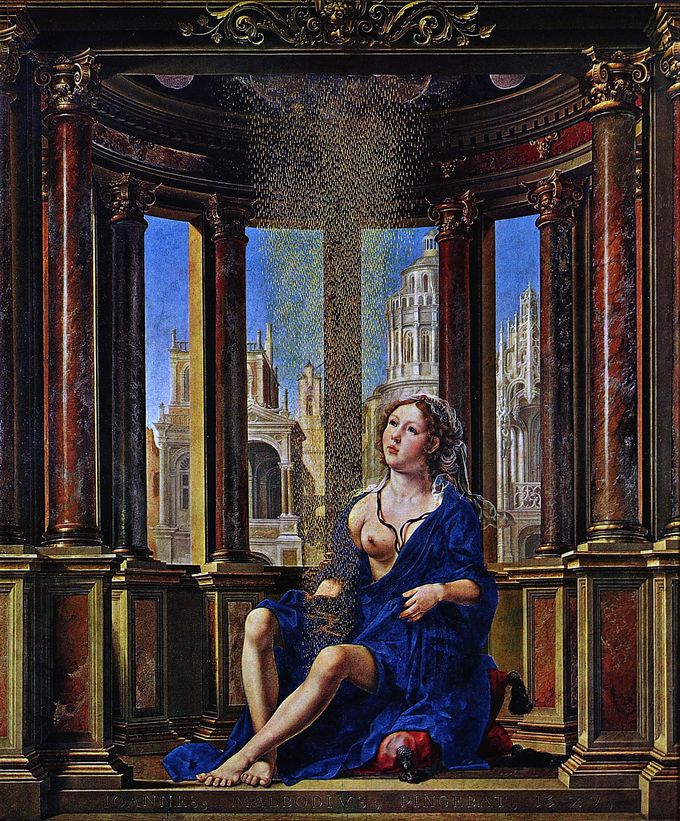
As Renaissance art styles moved through northern Europe, they were adapted to local community. For instance, in England and the northern Netherlands, the Reformation almost concluded the tradition of religious painting. In France, the School of Fontainebleau, which was originally founded by Italians such as Rosso Fiorentino, succeeded in establishing a durable national mode. Finally, by the end of the 16th century, artists such as Karel van Mander and Hendrik Goltzius nerveless in Haarlem in a cursory but intense stage of Northern Mannerism that also spread to Flanders.
Touch of the Protestant Reformation
The Reformation was a religious move in the 16th century that resulted in the theological divide betwixt Roman Catholics and Protestants.
- Art that portrayed religious figures or scenes followed Protestant theology by depicting people and stories accurately and clearly and emphasized salvation through divine grace, rather than through personal deeds, or by intervention of church bureaucracy.
- Reformation art embraced Protestant values, although the corporeality of religious art produced in Protestant countries was hugely reduced. Instead, many artists in Protestant countries diversified into secular forms of art like history painting, landscapes, portraiture, and still life.
- The Protestant Reformation induced a wave of iconoclasm, or the destruction of religious imagery, among the more than radical evangelists.
- The Northern way was characterized past the inclusion of decorative objects and detail.
- Protestant Reformation: The 16th century schism within Western Christianity initiated by Martin Luther, John Calvin, and other early Protestants; characterized by the objection to the doctrines, rituals, and ecclesiastical structure of the Roman Catholic Church and led to the cosmos of Protestant churches, which were exterior of the command of the Vatican.
- iconoclasm: The belief in, participation in, or sanction of destroying religious icons and other symbols or monuments, normally with religious or political motives.
The Protestant Reformation and Art
The Protestant Reformation was a religious motility that occurred in Western Europe during the 16th century that resulted in the theological dissever between Roman Catholics and Protestants. Information technology began with the nailing of his 95 Theses to the church door in 1517 by Martin Luther which set out his argument with many of the practices of the Cosmic Church like the selling of indulgences. This move created a North-South split in Europe, where more often than not Northern countries became Protestant, while Southern countries remained Cosmic. Protestant theology centered on the individual relationship between the worshiper and the divine, and appropriately, the Reformation'southward creative movement focused on the private's personal relationship with God. This was reflected in a number of common people and day-to-day scenes depicted in fine art.
The Reformation ushered in a new creative tradition that highlighted the Protestant belief system and diverged drastically from southern European humanist art produced during the High Renaissance. Reformation art embraced Protestant values, although the corporeality of religious art produced in Protestant countries was hugely reduced (largely because a huge patron for the arts—the Catholic Church— was no longer active in these countries). Instead, many artists in Protestant countries diversified into secular forms of art like history painting, landscapes, portraiture, and still life.
Art that portrayed religious figures or scenes followed Protestant theology by depicting people and stories accurately and conspicuously and emphasized salvation through divine grace, rather than through personal deeds, or by intervention of church bureaucracy. This is the direct influence of i major criticism of the Cosmic Church building during the Reformation—that painters created biblical scenes that strayed from their true story, were hard to place, and were embellished with painterly effects instead of focusing on the theological message. In terms of subject matter, iconic images of Christ and scenes from the Passion became less frequent, as did portrayals of the saints and clergy. Instead, narrative scenes from the Bible and moralistic depictions of modern life became prevalent.
The Protestant Reformation also capitalized on the popularity of printmaking in northern Europe. Printmaking allowed images to exist mass produced and widely available to the public at low cost. The Protestant church building was therefore able to bring their theology to the people through portable, inexpensive visual media. This allowed for the widespread availability of visually persuasive imagery. With the great development of the engraving and printmaking market in Antwerp in the 16th century, the public was provided with accessible and affordable images. Many artists provided drawings to book and print publishers.
Iconoclasm and Resistance to Idolatry
All forms of Protestantism showed a degree of hostility to religious images, especially sculpture and large paintings, considering them forms of idol worship. After the early on years of the Reformation, artists in Protestant areas painted far fewer religious subjects for public brandish, partly considering religious art had long been associated with the Catholic Church. Although, in that location was a conscious effort to develop a Protestant iconography of Bible images in book illustrations and prints. During the early Reformation, some artists made paintings for churches that depicted the leaders of the Reformation in ways very similar to Catholic saints. After, Protestant taste turned away from the display of religious scenes in churches, although some connected to be displayed in homes.
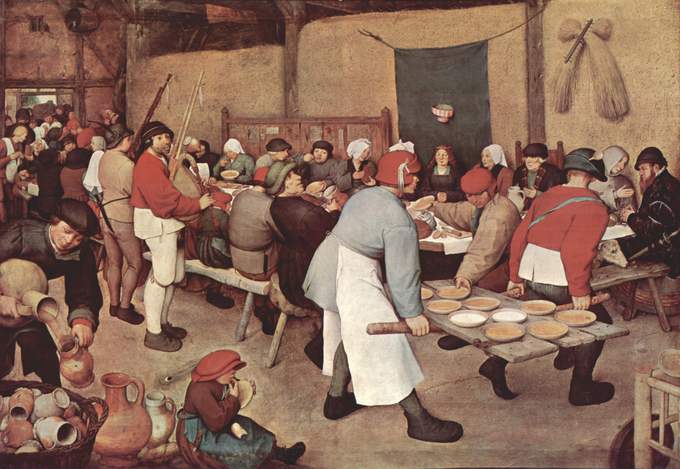
There was likewise a reaction against images from classical mythology, the other manifestation of the High Renaissance at the fourth dimension. This brought about a style that was more directly related to accurately portraying the nowadays times. For instance, Bruegel's Hymeneals Feast portrays a Flemish-peasant wedding dinner in a barn. It makes no reference to whatever religious, historical, or classical events, and but gives insight into the everyday life of the Flemish peasant.
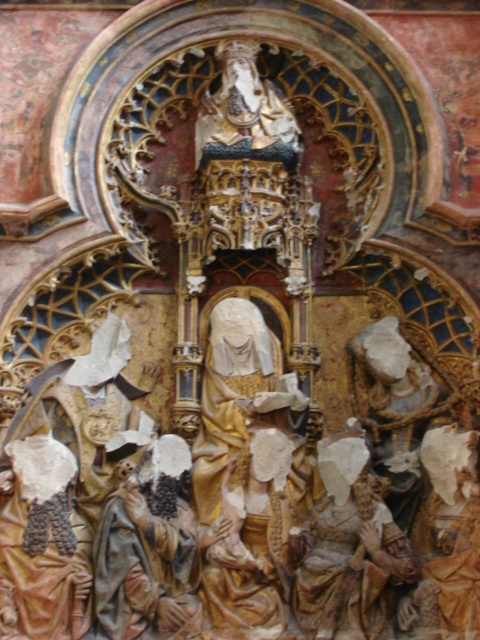
The Protestant Reformation induced a wave of iconoclasm, or the destruction of religious imagery, amongst the more than radical evangelists. Protestant leaders, specially Huldrych Zwingli and John Calvin, actively eliminated imagery from their churches and regarded the peachy majority of religious images as idolatrous—even obviously crosses. On the other hand, Martin Luther encouraged the display of a restricted range of religious imagery in churches which gave rise to iconoclasm across the Protestant countries. For the near part, however, Reformation iconoclasm resulted in a disappearance of religious figurative art, compared with the number of secular pieces that emerged.
Antwerp: A Center of the Northern Renaissance
Antwerp, located in Belgium, was a center for art in holland and northern Europe for much of the 16th and 17th centuries.
- The Antwerp School for painting flourished during the 16th and 17th centuries. The Antwerp School comprised many generations of artists and is known for portraiture, animal paintings, still lifes, and prints.
- Antwerp Mannerism bore no relation to Renaissance Mannerism, but the name suggests a reaction to the "classic" manner of the earlier Flemish painters. Although attempts have been made to identify individual artists, near paintings remain attributed to anonymous masters.
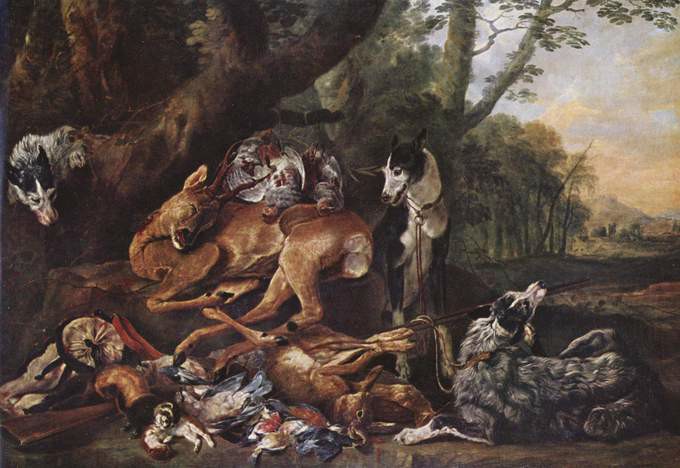
- Antwerp was an internationally significant publishing heart, with prodigious production of old primary prints and book illustrations. Furthermore, Antwerp animaliers, or animal painters, such as Frans Snyders, Jan Fyt, and Paul de Vos, dominated fauna painting in Europe.
- Antwerp School: The Antwerp Schoolhouse is a term for the artists active in Antwerp, starting time during the 16th century when the urban center was the economic centre of the Low Countries, and then during the 17th century when it became the artistic stronghold of the Flemish Baroque under Peter Paul Rubens.
- Antwerp: A province of Flanders, Belgium.
Antwerp, located in nowadays-day Belgium, was a center for art in holland and northern Europe for much of the 16th and 17th centuries. The so-called Antwerp Schoolhouse for painting flourished during the 16th century when the metropolis was the economical center of the Depression Countries, and again during the 17th century when it became the artistic stronghold of the Flemish Baroque. The Antwerp Schoolhouse comprised many generations of artists and is known for portraiture, creature paintings, still lifes, and prints.
Antwerp became the main trading and commercial centre of the Low Countries around 1500, and the boost in the economy attracted many artists to the cities to join craft guilds. For example, many 16th century painters, artists, and craftsmen joined the Order of Saint Luke, which educated apprentices and guaranteed quality. The first school of artists to emerge in the city were the Antwerp Mannerists, a group of bearding tardily Gothic painters agile in the city from most 1500 to 1520.
Antwerp Mannerism bore no straight relation to Renaissance or Italian Mannerism, but the name suggests a style that was a reaction to the "archetype" style of the earlier Flemish painters. Although attempts have been made to identify individual artists, most paintings remain attributed to anonymous masters. Characteristic of Antwerp Mannerism are paintings that combine early Netherlandish and Northern Renaissance styles, and contain both Flemish and Italian traditions into the same compositions. Practitioners of the style ofttimes painted subjects such every bit the Adoration of the Magi and the Nativity, both of which are generally represented as dark scenes, crowded with figures and dramatically illuminated. The Adoration scenes were particularly popular with the Antwerp Mannerists, who delighted in the patterns of the elaborate clothes worn by the Magi and the ornamentation of the architectural ruins in which the scene was set. That level of detail in patterning is characteristic of the North at this moment.
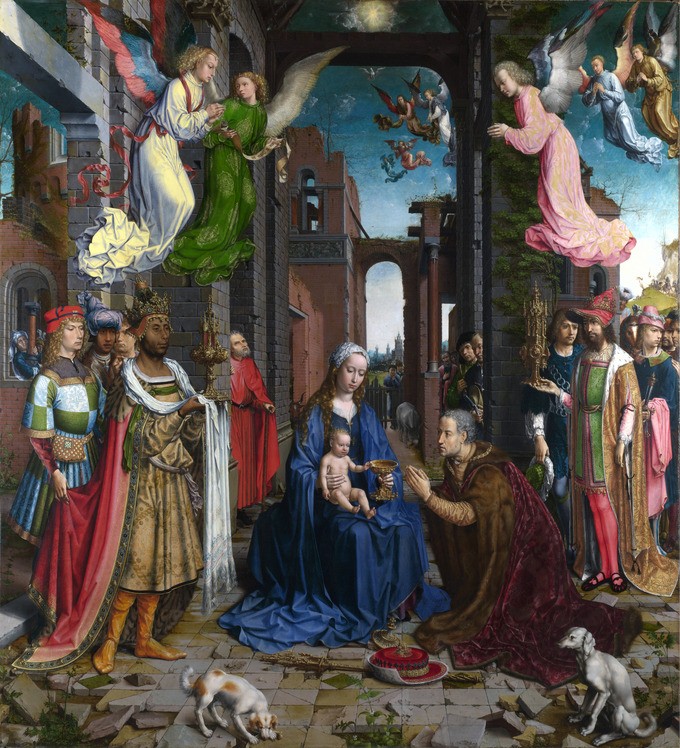
The iconoclastic riots ("Beeldenstorm" in Dutch) of 1566 that preceded the Dutch Revolt resulted in the devastation of many works of religious art, after which time the churches and monasteries had to be refurnished and redecorated. Artists such as Otto van Veen and members of the Francken family, working in a tardily Mannerist style, provided new religious decoration. These as well marked the beginning of economic turn down in the metropolis, as the Scheldt river was blockaded by the Dutch Republic in 1585 and trade restricted.
The urban center experienced an creative renewal in the 17th century. The large workshops of Peter Paul Rubens and Jacob Jordaens, along with the influence of Anthony van Dyck, fabricated Antwerp the middle of the Flemish Bizarre. The city was an internationally significant publishing center, with prodigious production of old main prints and book illustrations. Furthermore, Antwerp animaliers or animal painters, such as Frans Snyders, Jan Fyt, and Paul de Vos, dominated animal painting in Europe for at least the first half of the century. Just as the economy continued to decline, and the Habsburg nobility and the Church building reduced their patronage, many artists trained in Antwerp left for the Netherlands, England, France, or elsewhere. Past the stop of the 17th century, Antwerp was no longer a major artistic middle.
Mannerism
Loftier Renaissance painting evolved into Mannerism in Florence. Mannerist artists, who consciously rebelled against the principles of High Renaissance, tended to correspond elongated figures in illogical spaces. Modernistic scholarship has recognized the capacity of Mannerist art to convey potent, often religious, emotion where the High Renaissance failed to do and then. Some of the main artists of this menstruation are Pontormo, Bronzino, Rosso Fiorentino, Parmigianino and Raphael's student, Giulio Romano.
Mannerist artists began to turn down the harmony and ideal proportions of the Renaissance in favor of irrational settings, artificial colors, unclear subject area matters, and elongated forms.
- Draw the Mannerist style, how information technology differs from the Renaissance, and reasons why it emerged.
- Mannerism came later the Loftier Renaissance and before the Baroque.
- The artists who came a generation after Raphael and Michelangelo had a dilemma. They could not surpass the groovy works that had already been created by Leonardo da Vinci, Raphael, and Michelangelo. This is when nosotros start to see Mannerism emerge.
- Jacopo da Pontormo (1494–1557) represents the shift from the Renaissance to the Mannerist style.
- Mannerist painting encompasses a variety of approaches influenced by, and reacting to, the harmonious ideals and restrained naturalism associated with High Renaissance artists. Mannerism is notable for its intellectual sophistication too as its artificial (equally opposed to naturalistic) qualities.
- Mannerism developed in both Florence and Rome, from around 1520 until about 1580. The early Mannerist painters are notable for elongated forms, precariously balanced poses, a complanate perspective, irrational settings, and theatrical lighting.
- Mannerism: Style of art in Europe from c. 1520–1600. Mannerism came subsequently the High Renaissance and before the Bizarre. Not every creative person painting during this period is considered a Mannerist artist.
- Sack of Rome: A armed services event carried out on May vi, 1527 by the mutinous troops of Charles V, Holy Roman Emperor in Rome.
Style
What makes a work of art Mannerist? First we must understand the ideals and goals of the Renaissance. During the Renaissance artists were engaging with classical antiquity in a new way. In improver, they developed theories on perspective, and in all ways strived to create works of art that were perfect, harmonious, and showed platonic depictions of the natural world. Leonardo da Vinci, Raphael, and Michelangelo are considered the artists who reached the greatest achievements in art during the Renaissance.
The Renaissance stressed harmony and dazzler and no ane could create more cute works than the smashing three artists listed above. The artists who came a generation after had a dilemma; they could not surpass the great works that had already been created by da Vinci, Raphael, and Michelangelo. This is when nosotros start to meet Mannerism emerge. Younger artists trying to practise something new and different began to reject harmony and ideal proportions in favor of irrational settings, bogus colors, unclear discipline matters, and elongated forms.
Mannerism adult in both Florence and Rome. The early Mannerist painters in Florence—peculiarly Jacopo da Pontormo and Rosso Fiorentino, both students of Andrea del Sarto—are notable for using elongated forms, precariously balanced poses, a collapsed perspective, irrational settings, and theatrical lighting. Parmigianino (a student of Correggio) and Giulio Romano (Raphael's head banana) were moving in similarly stylized aesthetic directions in Rome. These artists had matured nether the influence of the High Renaissance, and their style has been characterized as a reaction or exaggerated extension of it.
Jacopo da Pontormo
Jacopo da Pontormo (1494–1557) represents the shift from the Renaissance to the Mannerist style. Take for example his Deposition from the Cross, an altarpiece that was painted for a chapel in the Church of Santa Felicita, Florence. The figures of Mary and Jesus appear to exist a straight reference to Michelangelo's Pieta. Although the piece of work is called a "Deposition," there is no cross. Scholars also refer to this work as the "Entombment" only there is no tomb. This lack of clarity on subject field matter is a authentication of Mannerist painting. In add-on, the setting is irrational, well-nigh as if it is not in this world, and the colors are far from naturalistic. This work could not have been produced by a Renaissance artist. The Mannerist movement stresses dissimilar goals and this work of art by Pontormo demonstrates this new, and dissimilar style.
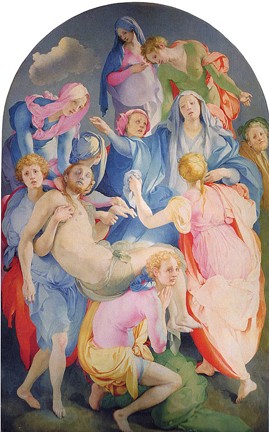
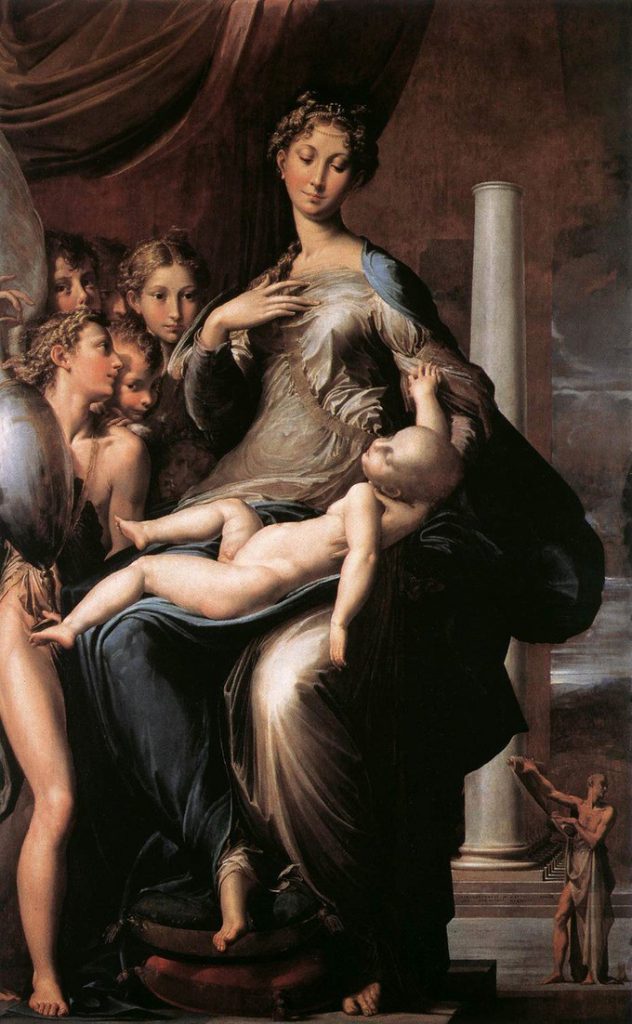
In other words, instead of studying nature directly, younger artists began studying Hellenistic sculptures and paintings of masters by. Therefore, this fashion is often identified as "anti-classical," notwithstanding at the time information technology was considered a natural progression from the Loftier Renaissance. The primeval experimental phase of Mannerism, known for its "anti-classical" forms, lasted until about 1540 or 1550. This catamenia has been described equally both a natural extension of the art of Andrea del Sarto, Michelangelo, and Raphael, besides as a decline of those same artists' classicizing achievements.
In by analyses, it has been noted that Mannerism arose in the early on 16th century alongside a number of other social, scientific, religious and political movements such as the Copernican model, the Sack of Rome, and the Protestant Reformation 'due south increasing challenge to the power of the Cosmic Church. Because of this, the fashion's elongated forms and distorted forms were in one case interpreted equally a reaction to the arcadian compositions prevalent in High Renaissance art.
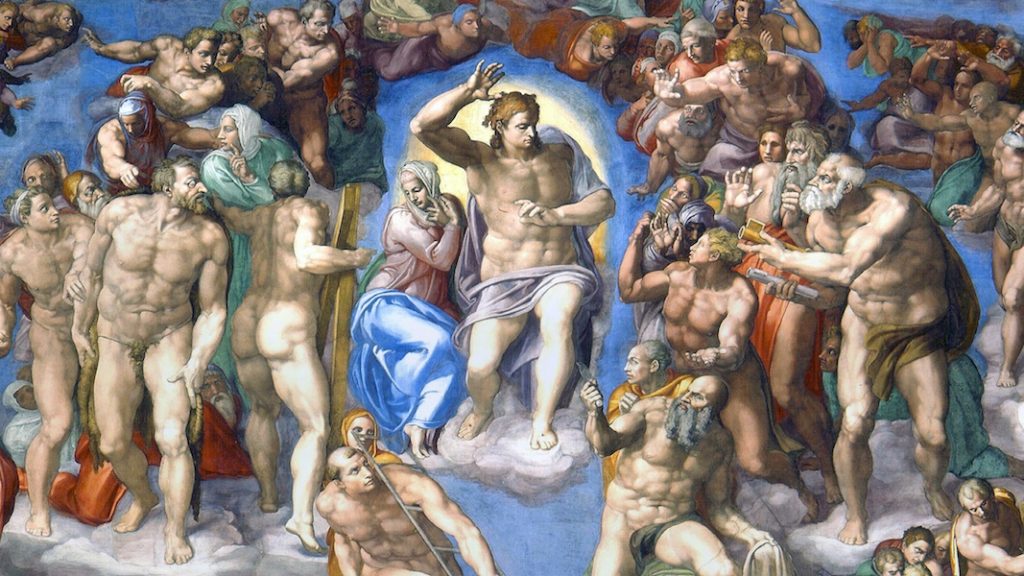
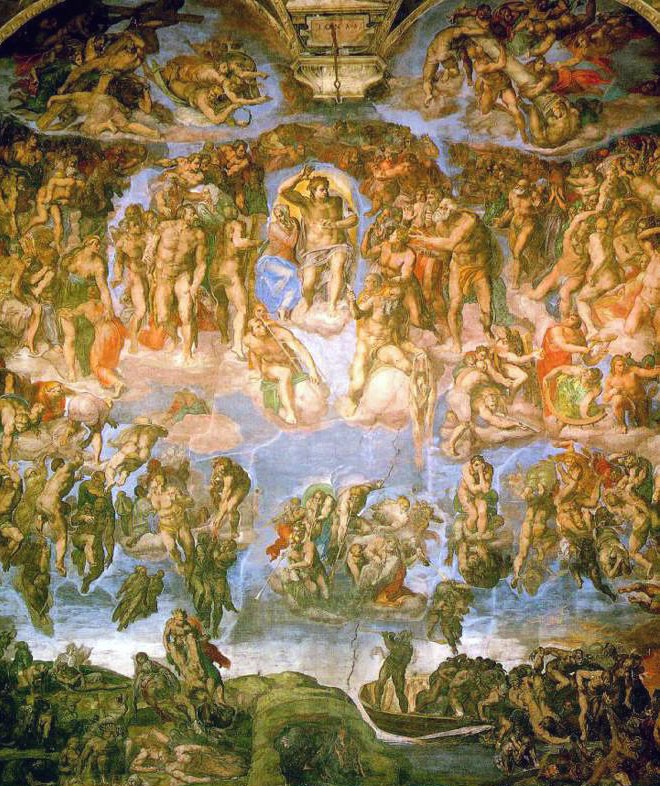
This explanation for the radical stylistic shift in 1520 has fallen out of scholarly favor, though the early Mannerists are still set in stark contrast to High Renaissance conventions; the immediacy and rest achieved by Raphael'south School of Athens no longer seemed interesting to young artists. Indeed, Michelangelo himself displayed tendencies towards Mannerism, notably in his foyer to the Laurentian Library, in the figures on his Medici tombs, and above all in the Last Judgment in the Sistine Chapel.
The Counter-Reformation Movement
While the Protestants largely removed public art from religion and moved towards a more "secular" manner of art, embracing the concept of glorifying God through depictions of nature, the Counter-Reformation Cosmic Church promoted art with "sacred" or religious content. In other words, art was to be strictly religious, created for the purpose of glorifying God and Catholic traditions.
To that end, The Terminal Judgment, a fresco on the altar wall of the Sistine Chapel by Michelangelo (1534–41), came under set on for its exaggerated classical imagery and the big quantity of nudes, some of which were interpreted at the fourth dimension as existence in compromising poses. Commissioned by Pope Clement Vii and finished iv years later for Pope Paul III, The Last Judgment was an object of dispute between critics inside the Cosmic Counter-Reformation and those who appreciated the genius of the artist and the Mannerist mode of the painting. The critics defendant Michelangelo of existence insensitive to proper decorum, and of flaunting personal style over appropriate depictions of content. The fresco was as well completed at a time when prints could be made of the work and distributed throughout Northern Europe, where information technology was feared it could fuel criticisms confronting the Catholic Church. While Michelangelo had been celebrated during the Renaissance for his classical influence and depictions of monumental nudes in a variety of poses, he was at present being criticized for the nudity, as well every bit the exaggerated musculature of figures and the dramatic, swirling composition that suggested Mannerism. The Sistine ceiling of some 22 years earlier had, in fact, included the young male figures without clear purpose or clothing which were called "ignudi." In 1534, however, clerics like the Pope's Chief of Ceremonies, Biagio da Cesena, was a abiding irritant to Michelangelo over the issue of nudity. This demonstrates how the historical situation had contradistinct and simply how threatened the Catholic Church building felt at this fourth dimension in history.
The artist took his revenge on his critics by painting da Cesena into the fresco in the lower right every bit the King of Hell (non the Devil) with a large ophidian swallowing his genitalia.
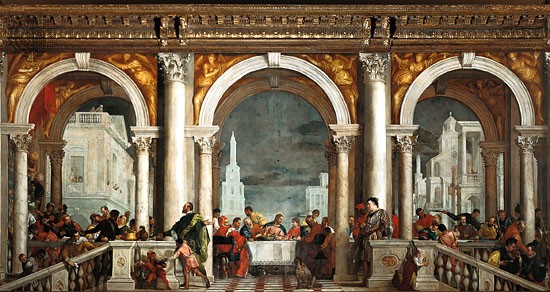
On the other hand, in Paolo Veronese'due south painting The Last Supper (subsequently renamed The Feast in the House of Levi), one tin can see what the Council regarded as inappropriate. Veronese was summoned before the Inquisition on the basis that his limerick was indecorous for the refectory of a monastery. The painting shows a fantasy version of a Venetian patrician feast, with, in the words of the Inquisition: "buffoons, drunken Germans, dwarfs and other such scurrilities" as well as improvident costumes and settings. Veronese was told that he must modify his painting inside a three-month menstruation; instead he simply changed the championship to The Feast in the Firm of Levi.
Source: https://boisestate.pressbooks.pub/arthistory/chapter/the-northern-renaissance-and-mannerism/
0 Response to "A Style of Art Prevalent After the High Renaissance in Italy Is Known Today as"
Post a Comment