Performed at the Berlin Wall Before It Again
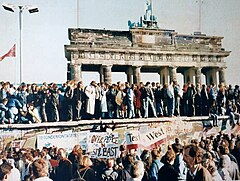 Germans stand up on tiptop of the Wall in front of Brandenburg Gate in the days before the Wall was torn downwardly | |
| Engagement | 9 November 1989 (1989-11-09) |
|---|---|
| Fourth dimension | 18:53–xix:01 (CET; UTC+1, press conference)[one] |
| Location | East Berlin, East Federal republic of germany W Berlin, Due west Frg |
| Cause | Revolutions of 1989 |
The autumn of the Berlin Wall (German: Mauerfall) on 9 November 1989 was a pivotal event in world history which marked the falling of the Iron Curtain and the start of the autumn of communism in Eastern and Central Europe. The fall of the inner German language border took identify shortly afterwards. An terminate to the Cold War was declared at the Malta Summit three weeks later on and the German language reunification took identify in Oct the following yr.
Background [edit]
Opening of the Atomic number 26 Curtain [edit]

The opening of the Atomic number 26 Curtain between Austria and Hungary at the Pan-European Picnic on 19 August 1989 set in motion a peaceful concatenation reaction, at the finish of which there was no longer an East Federal republic of germany and the Eastern Bloc had disintegrated. All-encompassing advertising for the planned picnic was made by posters and flyers amid the GDR holidaymakers in Hungary. It was the largest escape movement from East Frg since the Berlin Wall was built in 1961. Subsequently the picnic, which was based on an idea past Otto von Habsburg to test the reaction of the USSR and Mikhail Gorbachev to an opening of the border, tens of thousands of media-informed E Germans ready off for Hungary. Erich Honecker dictated to the Daily Mirror for the Paneuropa Picnic: "Habsburg distributed leaflets far into Poland, on which the Due east German holidaymakers were invited to a picnic. When they came to the picnic, they were given gifts, food and Deutsche Marker, so they were persuaded to come to the West." The leadership of the GDR in East Berlin did not dare to completely block the borders of their own country and the USSR did not reply at all. Thus the bracket of the Eastern Bloc was broken.[ii] [3] [4] [v] [half-dozen] [seven]
Following the summertime of 1989, by early November refugees were finding their mode to Republic of hungary via Czechoslovakia or via the West German embassy in Prague.
The emigration was initially tolerated because of long-continuing agreements with the communist Czechoslovak government, assuasive free travel beyond their common border. However, this move of people grew so large it caused difficulties for both countries. In addition, Due east Germany was struggling to meet loan payments on foreign borrowings; Egon Krenz sent Alexander Schalck-Golodkowski to unsuccessfully ask West Deutschland for a short-term loan to make interest payments.[8] : 344
Political changes in E Germany [edit]
On 18 Oct 1989, longtime Socialist Unity Party of Deutschland (SED) leader Erich Honecker stepped downward in favor of Krenz. Honecker had been seriously ill, and those looking to supercede him were initially willing to wait for a "biological solution", only past October were convinced that the political and economic situation was too grave.[viii] : 339 Honecker approved the choice, naming Krenz in his resignation spoken communication,[9] and the Volkskammer duly elected him. Although Krenz promised reforms in his first public speech,[10] he was considered past the East German public to exist post-obit his predecessor's policies, and public protests demanding his resignation continued.[8] : 347 Despite promises of reform, public opposition to the regime continued to grow.
On 1 November, Krenz authorized the reopening of the border with Czechoslovakia, which had been sealed to prevent East Germans from fleeing to West Germany.[11] On 4 Nov, the Alexanderplatz demonstration took place.[12]
On half-dozen Nov, the Interior Ministry published a draft of new travel regulations, which made cosmetic changes to Honecker-era rules, leaving the blessing process opaque and maintaining doubtfulness regarding access to foreign currency. The draft enraged ordinary citizens, and was denounced as "consummate trash" by West Berlin Mayor Walter Momper.[13] Hundreds of refugees crowded onto the steps of the West German embassy in Prague, enraging the Czechoslovaks, who threatened to seal off the E German-Czechoslovak border.[fourteen]
On 7 Nov, Krenz approved the resignation of Prime number Minister Willi Stoph and two-thirds of the Politburo; however Krenz was unanimously re-elected as General Secretary by the Central Committee.[eight] : 341
New East High german emigration policy [edit]
On nineteen October, Krenz asked Gerhard Lauter to draft a new travel policy.[15] Lauter was a quondam People'due south Police force officer. After rising rapidly through the ranks he had recently been promoted to a position with the Interior Ministry ("Home Function" / "Department of the Interior") as caput of the department responsible for issuing passports and the registration of citizens.[sixteen]
At a Politburo coming together on 7 November it was decided to enact a portion of the draft travel regulations addressing permanent emigration immediately. Initially, the Politburo planned to create a special edge crossing near Schirnding specifically for this emigration.[17] Interior Ministry officials and Stasi bureaucrats charged with drafting the new text, however, ended this was not feasible, and crafted a new text relating to both emigration and temporary travel. It stipulated that Due east German language citizens could use for permission to travel abroad without having to meet the previous requirements for those trips.[eighteen] To ease the difficulties, the Politburo led by Krenz decided on 9 November to allow refugees to exit directly through crossing points between East Germany and West Germany, including between East and West Berlin. Later the same twenty-four hours, the ministerial administration modified the proposal to include individual, round-trip, travel. The new regulations were to have event the next day.[19]
VVS b2-937/89 [edit]
| Text of the regulation | |
|---|---|
| Original High german[20] | English translation[21] |
| Zur Veränderung der Situation der ständigen Ausreise von DDR-Bürgern nach der BRD über die CSSR wird festgelegt: 1) Die Verordnung vom xxx. November 1988 über Reisen von Bürgern der DDR in das Ausland (GBl. I Nr. 25 S. 271) findet bis zur Inkraftsetzung des neuen Reisegesetzes keine Anwendung mehr. ii) Ab sofort treten folgende zeitweilige Übergangsregelungen für Reisen und ständige Ausreisen aus der DDR in das Ausland in Kraft: a. Privatreisen nach dem Ausland können ohne Vorliegen von Voraussetzungen (Reiseanlässe und Verwandtschaftsverhältnisse) beantragt werden. Dice Genehmigungen werden kurzfristig erteilt. Versagungsgründe werden nur in besonderen Ausnahmefällen angewandt. b. Die zuständigen Abteilungen Paß- und Meldewesen der VPKÄ in der DDR sind angewiesen, Visa zur ständigen Ausreise unverzüglich zu erteilen, ohne daß dafür noch geltende Voraussetzungen für eine ständige Ausreise vorliegen müssen. Die Antragstellung auf ständige Ausreise ist wie bisher auch bei den Abteilungen Innere Angelegenheiten möglich. c. Ständige Ausreisen können über alle Grenzübergangsstellen der DDR zur BRD bzw. zu Berlin (W) erfolgen. d. Damit entfällt dice vorübergehend ermöglichte Erteilung von entsprechenden Genehmigungen in Auslandsvertretungen der DDR bzw. dice ständige Ausreise mit dem Personalausweis der DDR über Drittstaaten. three) Über die zeitweiligen Übergangsregelungen ist dice beigefügte Pressemitteilung am ten. November 1989 zu veröffentlichen. | To alter the situation with regard to the permanent exit of East German citizens to the West Deutschland via CSSR, it has been adamant that: 1. The decree from 30 Nov 1988 virtually travel away of Due east German citizens will no longer exist applied until the new travel law comes into force. 2. Starting immediately, the following temporary transition regulations for travel away and permanent exits from East Germany are in outcome: a) Applications by individual individuals for travel abroad tin can at present be made without the previously existing requirements (of demonstrating a need to travel or proving familial relationships). The travel authorizations will be issued within a short period of time. Grounds for denial will only be practical in particularly exceptional cases. b) The responsible departments of passport and registration control in the People'due south Law commune offices in E Germany are instructed to issue visas for permanent get out without delays and without presentation of the existing requirements for permanent exit. Information technology is notwithstanding possible to employ for permanent exit in the departments for internal affairs [of the local commune or city councils]. c) Permanent exits are possible via all East High german border crossings to Due west Germany and (West) Berlin. d) The temporary do of issuing (travel) authorizations through East High german consulates and permanent exit with just an East German personal identity carte du jour via third countries ceases. 3. The attached press release explaining the temporary transition regulation volition exist issued on ten November. |
| Press release | |
|---|---|
| Original German language[20] | English translation[21] |
| Verantwortlich: Regierungssprecher beim Ministerrat der DDR Berlin (ADN) Wie die Presseabteilung des Ministeriums des Innern mitteilt, lid der Ministerrat der DDR beschlossen, daß bis zum Inkrafttreten einer entsprechenden gesetzlichen Regelung durch die Volkskammer folgende zeitweilige Übergangsregelung für Reisen und ständige Ausreisen aus der DDR ins Ausland in Kraft gesetzt wird: 1. Privatreisen nach dem Ausland können ohne Vorliegen von Voraussetzungen (Reiseanlässe und Verwandtschaftsverhältnisse) beantragt werden. Die Genehmigungen werden kurzfristig erteilt. Versagungsgründe werden nur in besonderen Ausnahmefällen angewandt. 2. Die zuständigen Abteilungen Paß- und Meldewesen der VPKÄ in der DDR sind angewiesen, Visa zur ständigen Ausreise unverzüglich zu erteilen, ohne daß dafür noch geltende Voraussetzungen für eine ständige Ausreise vorliegen müssen. Dice Antragstellung auf ständige Ausreise ist wie bisher auch bei den Abteilungen Innere Angelegenheiten möglich. 3. Ständige Ausreisen können über alle Grenzübergangsstellen der DDR zur BRD bzw. zu Berlin (West) erfolgen. 4. Damit entfällt dice vorübergehend ermöglichte Erteilung von entsprechenden Genehmigungen in Auslandsvertretungen der DDR bzw. die ständige Ausreise mit dem Personalausweis der DDR über Drittstaaten. | Responsible: Authorities spokesman of East Germany; Council of Ministers Berlin (ADN) As the Printing Part of the Ministry of the Interior has appear, the E German Council of Ministers has decided that the post-obit temporary transition regulation for travel abroad and permanent exit from East Frg will exist constructive until a corresponding law is put into effect past the Volkskammer: 1) Applications by individual individuals for travel abroad can now be made without the previously existing requirements (of demonstrating a need to travel or proving familial relationships). The travel authorizations volition exist issued within a brusque flow of fourth dimension. Grounds for denial will only be applied in particularly exceptional cases. 2) The responsible departments of passport and registration control in the People's Police district offices in East Germany are instructed to issue visas for permanent get out without delays and without presentation of the existing requirements for permanent get out. Information technology is yet possible to employ for permanent exit in the departments for internal diplomacy [of the local district or city councils]. 3) Permanent exits are possible via all East High german border crossings to W Germany and (Due west) Berlin. 4) This conclusion revokes the temporary exercise of issuing (travel) authorizations through East German language consulates and permanent exit with only an E German language personal identity card via third countries ceases. |
Events [edit]
Misinformed public announcements [edit]
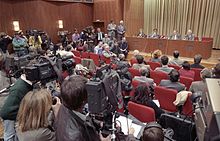
The press briefing on nine November 1989 by Günter Schabowski (seated on phase, second from right) and other E German officials which led to the fall of the Wall. Riccardo Ehrman is sitting on the floor of the podium with the table but behind him.[one]
The announcement of the regulations which brought down the Wall took place at an hour-long press conference led by Günter Schabowski, the political party leader in E Berlin and the elevation government spokesman, starting time at 18:00 CET on 9 November and broadcast live on East High german tv and radio. Schabowski was joined by Minister of Foreign Merchandise Gerhard Beil and Central Committee members Helga Labs and Manfred Banaschak.[1] [8] : 352
Schabowski had not been involved in the discussions most the new regulations and had not been fully updated.[22] Shortly earlier the printing conference, he was handed a annotation from Krenz announcing the changes, merely given no further instructions on how to handle the data. The text stipulated that East High german citizens could apply for permission to travel away without having to meet the previous requirements for those trips, and also allowed for permanent emigration betwixt all border crossings—including those between East and West Berlin.[xviii]
At eighteen:53, nigh the end of the press conference, ANSA's Riccardo Ehrman asked if the typhoon travel police of 6 November was a error. Schabowski gave a confusing respond that asserted it was necessary because Due west Germany had wearied its chapters to have fleeing Due east Germans, then remembered the annotation he had been given and added that a new law had been drafted to permit permanent emigration at whatever border crossing. This caused a stir in the room; among several questions at one time, Schabowski expressed surprise that the reporters had not notwithstanding seen this law, and started reading from the note.[ane] After this, a reporter, either Ehrman or Bild-Zeitung reporter Peter Brinkmann, both of whom were sitting in the front row at the press conference,[23] [24] [25] asked when the regulations would have effect.[i] After a few seconds' hesitation, Schabowski replied, "Equally far as I know, information technology takes effect immediately, without delay" (German: Das tritt nach meiner Kenntnis ... ist das sofort ... unverzüglich.)[26] [27] [8] : 352 This was an apparent assumption based on the note's opening paragraph; as Beil attempted to interject that information technology was upwards to the Council of Ministers to decide when it took effect, Schabowski proceeded to read this clause, which stated it was in event until a law on the thing was passed by the Volkskammer. Crucially, a announcer then asked if the regulation likewise applied to the crossings to West Berlin. Schabowski shrugged and read particular 3 of the annotation, which confirmed that it did.[1] [24]
Later on this exchange, Daniel Johnson of The Daily Telegraph asked what this constabulary meant for the Berlin Wall. Schabowski saturday frozen before giving a rambling statement well-nigh the Wall existence tied to the larger disarmament question.[28] [29] He then ended the press conference promptly at nineteen:00 as journalists hurried from the room.[24] [ane]
Subsequently the press conference, Schabowski sat for an interview with NBC News anchor Tom Brokaw in which he repeated that E Germans would be able to emigrate through the border and the regulations would go into outcome immediately.[xxx] [31]
Spreading news [edit]

The news began spreading immediately: the Due west High german Deutsche Presse-Agentur issued a message at 19:04 which reported that Eastward German citizens would be able to cross the inner German border "immediately". Excerpts from Schabowski'southward press briefing were broadcast on West Deutschland'southward 2 main news programs that nighttime—at nineteen:17 on ZDF'southward heute, which came on the air as the press briefing was ending, and as the pb story at 20:00 on ARD'due south Tagesschau. Equally ARD and ZDF had broadcast to about all of East Germany since the late 1950s, were far more widely viewed than the East High german channels, and had become accustomed by the East German authorities, this is how most of the population heard the news. Afterward that night, on ARD's Tagesthemen, anchorman Hanns Joachim Friedrichs proclaimed, "This 9 Nov is a historic day. The German democratic republic has announced that, starting immediately, its borders are open to anybody. The gates in the Wall stand open broad."[8] : 353 [22]
In 2009, Ehrman claimed that a member of the Primal Committee had called him and urged him to inquire most the travel police during the printing conference, simply Schabowski called that absurd.[25] Ehrman later recanted this statement in a 2022 interview with an Austrian announcer, admitting that the caller was Günter Pötschke, head of the East German news bureau ADN, and he only asked if Ehrman would nourish the press conference.[32]
Peace prayers at Nikolai Church building [edit]

Despite the policy of country disbelief in Due east Germany, Christian pastor Christian Führer regularly met with his congregation at St. Nicholas Church for prayer since 1982.[33] [34] Over the next vii years, the Church grew, despite government barricading the streets leading to information technology, and after church building services, peaceful candlelit marches took place.[33] The secret constabulary issued expiry threats and even attacked some of the marchers, but the crowd still continued to assemble.[33] On 9 October 1989, the police and ground forces units were given permission to use force against those assembled, but this did not deter the church service and march from taking identify, which gathered 70,000 people.[33] [34] Many of those people started to cantankerous into East Berlin, without a shot existence fired.[33]
Crowding of the edge [edit]
After hearing the broadcast, Eastward Germans began gathering at the Wall, at the six checkpoints between East and Due west Berlin, demanding that border guards immediately open the gates.[22] The surprised and overwhelmed guards made many hectic phone calls to their superiors about the problem. At outset, they were ordered to find the "more aggressive" people gathered at the gates and stamp their passports with a special stamp that barred them from returning to East Germany—in issue, revoking their citizenship. All the same, this still left thousands of people enervating to be let through "as Schabowski said we tin".[eight] : 353 It soon became articulate that no i among the Due east German government would take personal responsibility for issuing orders to use lethal forcefulness, then the vastly outnumbered soldiers had no mode to hold dorsum the huge crowd of E German citizens. Mary Elise Sarotte in a 2009 Washington Mail service story characterized the series of events leading to the fall of the Wall as an blow, maxim "Ane of the most momentous events of the past century was, in fact, an accident, a semicomical and bureaucratic mistake that owes as much to the Western media as to the tides of history."[22]
Border openings [edit]
Finally, at 22:45 (alternatively given as 23:30) on 9 Nov, Harald Jäger, commander of the Bornholmer Straße border crossing, yielded, assuasive guards to open the checkpoints and letting people through with trivial or no identity-checking.[35] [36] As the Ossis swarmed through, they were greeted by Wessis waiting with flowers and champagne amid wild rejoicing. Soon later on, a crowd of Due west Berliners jumped on peak of the Wall and were soon joined by East German language youngsters.[37] The evening of 9 Nov 1989 is known as the night the Wall came downwards.[38]
-

Juggling on the Wall on 16 November 1989
-

"Mauerspecht" (November 1989)
-

The autumn of the Wall (November 1989)
-
Commemoration at the edge crossing in the Schlutup district of Lübeck
Another border crossing to the south may accept been opened before. An business relationship by Heinz Schäfer indicates that he also acted independently and ordered the opening of the gate at Waltersdorf-Rudow a couple of hours earlier.[39] This may explain reports of East Berliners appearing in West Berlin earlier than the opening of the Bornholmer Straße border crossing.[39]
"Wallpeckers" demolition [edit]
A Berlin Wall segment in Los Angeles at 5900 Wilshire Boulevard. 46 second video
Removal of the Wall began on the evening of 9 November 1989 and continued over the following days and weeks, with people nicknamed Mauerspechte (wallpeckers) using various tools to flake off souvenirs, demolishing lengthy parts in the process, and creating several unofficial edge crossings.[forty]
Tv set coverage of citizens demolishing sections of the Wall on 9 November was soon followed by the East German authorities announcing ten new edge crossings, including the historically significant locations of Potsdamer Platz, Glienicker Brücke, and Bernauer Straße. Crowds gathered on both sides of the historic crossings waiting for hours to cheer the bulldozers that tore down portions of the Wall to reconnect the divided roads. While the Wall officially remained guarded at a decreasing intensity, new edge crossings continued for some time. Initially the East High german Border Troops attempted repairing damage washed by the "wallpeckers"; gradually these attempts ceased, and guards became more than lax, tolerating the increasing demolitions and "unauthorized" border crossing through the holes.[41]
Prime number ministers meet [edit]
The Brandenburg Gate in the Berlin Wall was opened on 22 December 1989; on that date, West German Chancellor Helmut Kohl walked through the gate and was greeted by East German Prime Minister Hans Modrow.[42] West Germans and West Berliners were allowed visa-free travel starting 23 Dec.[41] Until then, they could simply visit East Germany and Eastward Berlin under restrictive weather condition that involved awarding for a visa several days or weeks in advance and obligatory exchange of at to the lowest degree 25 DM per twenty-four hours of their planned stay, all of which hindered spontaneous visits. Thus, in the weeks between ix November and 23 December, E Germans could really travel more freely than Westerners.[41]
Official demolition [edit]
On 13 June 1990, the Due east German Border Troops officially began dismantling the Wall,[43] [44] beginning in Bernauer Straße and effectually the Mitte district. From there, demolition connected through Prenzlauer Berg/Gesundbrunnen, Heiligensee and throughout the metropolis of Berlin until December 1990. Co-ordinate to estimates past the edge troops, a total of around 1.7 one thousand thousand tonnes of edifice rubble was produced by the demolition. Unofficially, the sabotage of the Bornholmer Straße began because of structure work on the railway. This involved a total of 300 German democratic republic edge guards and—after iii Oct 1990—600 Pioneers of the Bundeswehr. These were equipped with 175 trucks, 65 cranes, 55 excavators and 13 bulldozers. Virtually every road that was severed by the Berlin Wall, every road that in one case linked from Due west Berlin to East Berlin, was reconstructed and reopened by i August 1990. In Berlin alone, 184 km (114 mi) of wall, 154 km (96 mi) border debate, 144 km (89 mi) point systems and 87 km (54 mi) barrier ditches were removed. What remained were six sections that were to be preserved as a memorial. Various military units dismantled the Berlin/Brandenburg border wall, completing the chore in November 1991. Painted wall segments with artistically valuable motifs were put up for sale in 1990 in Berlin and Monte Carlo.[41]
On one July 1990, the day East Germany adopted the Due west German currency, all de jure border controls ceased, although the inter-German language edge had go meaningless for some time before that.[45] The demolition of the Wall was completed in 1994.[43]
The fall of the Wall marked the first critical step towards German reunification, which formally concluded a mere 339 days later on 3 Oct 1990 with the dissolution of Due east Federal republic of germany and the official reunification of the German state along the autonomous lines of the West German Bones Constabulary.[40]
-

An East German guard talks to a Westerner through a broken seam in the Wall in belatedly November 1989.
-
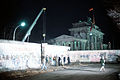
A crane removes a section of the Wall near Brandenburg Gate on 21 December 1989.
-
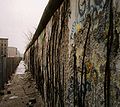
Almost all of the remaining sections were rapidly chipped away. December 1990.
-
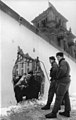
W Germans peer at East German edge guards through a hole in the Wall on 5 January 1990.
-

Souvenir clamper of physical from the Wall
International opposition [edit]
French President François Mitterrand and British Prime Minister Margaret Thatcher both opposed the fall of the Berlin Wall and the eventual reunification of Germany, fearing potential German designs on its neighbours using its increased strength. In September 1989, Margaret Thatcher privately confided to Soviet Full general Secretarial assistant Mikhail Gorbachev that she wanted the Soviet leader to do what he could to cease it.[46] [47]
We practice not want a united Germany. This would lead to a change to postwar borders and nosotros cannot let that because such a development would undermine the stability of the whole international situation and could endanger our security, Thatcher told Gorbachev.[46]
Afterwards the fall of the Berlin Wall, François Mitterrand warned Thatcher that a unified Germany could make more ground than Adolf Hitler ever had and that Europe would have to bear the consequences.[48]
Legacy [edit]
Celebrations and anniversaries [edit]
On 21 Nov 1989, Crosby, Stills & Nash performed the song "Chippin' Abroad" from Graham Nash's 1986 solo anthology Innocent Eyes in front end of the Brandenburg Gate.[49]
On 25 Dec 1989, Leonard Bernstein gave a concert in Berlin celebrating the end of the Wall, including Beethoven's 9th symphony (Ode to Joy) with the discussion "Joy" ( Freude ) changed to "Freedom" ( Freiheit ) in the lyrics sung. The poet Schiller may have originally written "Freedom" and changed information technology to "Joy" out of fear. The orchestra and choir were drawn from both Due east and West Frg, besides as the Great britain, France, the Soviet Union, and the United states of america.[50] On New year's day'southward Eve 1989, David Hasselhoff performed his song "Looking for Freedom" while standing atop the partly demolished Wall.[51] Roger Waters performed the Pinkish Floyd album The Wall only north of Potsdamer Platz on 21 July 1990, with guests including Bon Jovi, Scorpions, Bryan Adams, Sinéad O'Connor, Cyndi Lauper, Thomas Dolby, Joni Mitchell, Marianne Faithfull, Levon Helm, Rick Danko and Van Morrison.[52]
Over the years, there has been a repeated controversial fence[53] as to whether 9 November would make a suitable German language national vacation, often initiated past erstwhile members of political opposition in East Deutschland, such as Werner Schulz.[54] Besides being the emotional apogee of East Germany'due south peaceful revolution, 9 Nov is also the engagement of the 1918 abdication of Kaiser Wilhelm 2 and annunciation of the Weimar Republic, the kickoff German commonwealth. However, 9 Nov is as well the anniversary of the execution of Robert Blum post-obit the 1848 Vienna revolts, the 1923 Beer Hall Putsch and the infamous Kristallnacht pogroms of the Nazis in 1938. Nobel Laureate Elie Wiesel criticised the first euphoria, noting that "they forgot that 9 Nov has already entered into history—51 years before information technology marked the Kristallnacht."[55] Equally reunification was not official and complete until 3 October (1990), that twenty-four hours was finally chosen as German language Unity Day.
10th anniversary celebrations [edit]
On 9 November 1999, the tenth anniversary was observed with a concert and fireworks at the vid Brandenburg Gate. Russian cellist Mstislav Rostropovich played music by Johann Sebastian Bach, while German rock band Scorpions performed their 1990 vocal Air current of Alter. Wreaths were placed for victims shot downwards when they attempted to escape to the due west, and politicians delivered speeches.[56] [57]
20th anniversary celebrations [edit]
On ix November 2009, Berlin celebrated the 20th ceremony of the autumn of the Berlin Wall with a "Festival of Liberty" with dignitaries from effectually the earth in attendance for an evening celebration effectually the Brandenburg Gate. A high point was when over 1,000 colourfully designed foam domino tiles, each over viii feet (2.four m) alpine, that were stacked forth the old road of the Wall in the metropolis center were toppled in stages, converging in front of the Brandenburg Gate.[58]
A Berlin Twitter Wall was ready to let Twitter users to post messages commemorating the 20th anniversary. The Chinese government rapidly shut down access to the Twitter Wall after masses of Chinese users began using it to protest the Nifty Firewall of China.[59] [60] [61]
In the U.s., the German Diplomatic mission coordinated a public diplomacy campaign with the motto "Liberty Without Walls", to commemorate the 20th anniversary of the autumn of the Berlin Wall. The entrada was focused on promoting awareness of the fall of the Berlin Wall among electric current college students. Students at over 30 universities participated in "Freedom Without Walls" events in late 2009. First place winner of the Freedom Without Walls Speaking Contest[62] Robert Cannon received a free trip to Berlin for 2010.[63]
An international project called Mauerreise (Journeying of the Wall) took place in various countries. Twenty symbolic Wall bricks were sent from Berlin starting in May 2009, with the destinations being Korea, Cyprus, Yemen, and other places where everyday life is characterised past sectionalization and border experience. In these places, the bricks would go a blank canvas for artists, intellectuals and young people to tackle the "Wall" miracle.[64]
To commemorate the 20th ceremony of the fall of the Berlin Wall, the 3D online virtual globe Twinity reconstructed a truthful-to-scale section of the Wall in virtual Berlin.[65] The MTV Europe Music Awards, on 5 November, had U2 and Tokio Hotel perform songs dedicated to, and well-nigh the Berlin Wall. U2 performed at the Brandenburg Gate, and Tokio Hotel performed "Earth Behind My Wall".
Palestinians in the town of Kalandia, Due west Banking concern pulled down parts of the Israeli W Bank barrier, in a sit-in marking the 20th anniversary of the fall of the Berlin Wall.[66]
The International Spy Museum in Washington D.C., hosted a Trabant car rally where 20 Trabants gathered in recognition of the 20th anniversary of the fall of the Berlin Wall. Rides were raffled every half-hour and a Trabant crashed through a Berlin Wall mock upward. The Trabant was the E German people's car that many used to go out DDR after the collapse.[67] [68]
The Allied Museum in the Dahlem district of Berlin hosted a number of events to marker the 20th ceremony of the fall of the Berlin Wall. The museum held a Special Exhibition entitled "Wall Patrol – The Western Powers and the Berlin Wall 1961–1990" which focused on the daily patrols deployed by the Western powers to observe the state of affairs along the Berlin Wall and the fortifications on the GDR border.[69] A sheet of "Americans in Berlin" Commemorative Cinderella stamps designed by T.H.E. Colina, the author of the novel Voices Under Berlin, was presented to the Museum by David Guerra, Berlin veteran and webmaster of the site www.berlinbrigade.com. The stamps splendidly illustrate that even twenty years on, veterans of service in Berlin still regard their service there as ane of the high points of their lives.[70]
30th anniversary celebrations [edit]
Berlin planned a weeklong arts festival from 4 to x November 2022 and a citywide music festival on 9 November to celebrate the 30th anniversary.[71] [72] On 4 November, outdoor exhibits opened at Alexanderplatz, the Brandenburg Gate, the East Side Gallery, Gethsemane Church, Kurfürstendamm, Schlossplatz, and the quondam Stasi headquarters in Lichtenberg.[72]
Hertha Berlin commemorated the 30th anniversary of the fall of the Berlin Wall past tearing a fake Berlin Wall in their friction match against RB Leipzig.[73]
References [edit]
- ^ a b c d due east f yard "Wilson Center Digital Annal". digitalarchive.wilsoncenter.org.
- ^ Otmar Lahodynsky "Eiserner Vorhang: Picknick an der Grenze" (Iron curtain: picnic at the border – German language), in Profil 13 June 2019.
- ^ Thomas Roser: DDR-Massenflucht: Ein Picknick hebt die Welt aus den Angeln (German – Mass exodus of the German democratic republic: A picnic clears the earth) in: Dice Presse 16 August 2018.
- ^ Andreas Rödder, Federal republic of germany einig Vaterland – Die Geschichte der Wiedervereinigung (2009).
- ^ Miklós Németh in Interview, Austrian Telly – ORF "Report", 25 June 2019.
- ^ Hilde Szabo: Dice Berliner Mauer begann im Burgenland zu bröckeln (The Berlin Wall began to crumble in Burgenland – German language), in Wiener Zeitung 16 August 1999; Otmar Lahodynsky: Paneuropäisches Picknick: Die Generalprobe für den Mauerfall (Pan-European picnic: the clothes rehearsal for the fall of the Berlin Wall – German), in: Profil 9 August 2014.
- ^ Ludwig Greven "Und dann ging das Tor auf", in Die Zeit, 19 Baronial 2014.
- ^ a b c d e f g h Sebestyen, Victor (2009). Revolution 1989: The Fall of the Soviet Empire . New York City: Pantheon Books. ISBN978-0-375-42532-5.
- ^ Resignation Speech. Honecker. Archived from the original on 7 Nov 2021. Retrieved half dozen July 2019.
- ^ Günter Schabowski: Honeckers Absetzung. zeitzeugenportal. Archived from the original on 7 November 2021. Retrieved 6 July 2019.
- ^ "Communism – East Germany". BBC News. Retrieved 1 Apr 2010.
- ^ Sarotte 2014, p. 96.
- ^ Sarotte 2014, p. 97.
- ^ Sarotte 2014, p. 99.
- ^ Locke, Stefan. "Mauerfall am 9. November 1989: "Und im Übrigen: Die Grenze ist auf"". Faz.cyberspace. Frankfurter Allgemeine Zeitung. Retrieved 15 December 2020 – via world wide web.faz.net.
- ^ "Der Ghostwriter des Mauerfalls". Meine Geschichte: Gerhard Lauter. Mitteldeutscher Rundfunk (Mitglied der ARD), Leipzig. 9 November 2015. Retrieved 14 Dec 2020.
- ^ Sarotte 2014, pp. 99–100.
- ^ a b Sarotte 2014, pp. 107–108.
- ^ Schäfer, Hermann (2015). Deutsche Geschichte in 100 Objekten. München, Berlin, Zürich: Piper. p. 570. ISBN978-3-492057028.
- ^ a b ""Schabowskis Zettel": Zeitweilige Übergangsregelung des DDR-Ministerrates für Reisen und ständige Ausreise aus der DDR, 9. November 1989 | Chronik der Mauer". world wide web.chronik-der-mauer.de.
- ^ a b "Wilson Middle Digital Archive". digitalarchive.wilsoncenter.org.
- ^ a b c d Sarotte, Mary Elise (1 November 2009) "How information technology went downwardly: The little blow that toppled history" The Washington Mail service. Retrieved 2 November 2009.
- ^ Walker, Marcus (21 October 2009) "Did Brinkmannship Fell Berlin's Wall? Brinkmann Says It Did" The Wall Street Journal.
- ^ a b c "Pressekonferenz DDR-Reiseregelung [09.11.1989]". Archived from the original on 7 Nov 2022 – via YouTube.
- ^ a b Kirchner, Stephanie (19 April 2009). "Berlin Wall: Was the Fall Engineered by the German democratic republic?". Time. Archived from the original on 22 April 2009. Retrieved 18 June 2019.
- ^ "Schabowskis Ehefrau: 'Mein Mann wusste, was er sagte'". Faz.net (in German). Frankfurter Allgemeine Zeitung. 7 Nov 2014. Retrieved one November 2015.
- ^ Hemmerich, Lisa (9 November 2009). "Schabowskis legendärer Auftritt: Das folgenreichste Versehen der DDR-Geschichte" [The almost consequential oversight of Gdr history]. Spiegel Online (in German).
- ^ Sarotte 2014, p. 118.
- ^ Walker, Marcus (21 Oct 2009) "Did Brinkmannship Fell Berlin's Wall? Brinkmann Says It Did" The Wall Street Periodical.
- ^ Schabowski replied to Brokaw in broken English that Eastward Germans were "not further forced to exit Gdr past transit through another country", and could now "go through the edge". When Brokaw asked if this meant "freedom of travel", Schabowski replied, "Yes of course", and added that it was not "a question of tourism", just "a permission of leaving GDR". Sarotte, p. 129.
- ^ "Brokaw reports from the Berlin Wall". NBC News. nine Nov 1989. Retrieved 18 June 2019.
- ^ "Der verschwiegene Mauerfall". Die Presse (in German). 31 October 2014.
- ^ a b c d e f Welle, Deutsche (vii January 2009). "Peace prayers helped bring downwards the Wall, says Leipzig pastor". Deutsche Welle.
- ^ a b Crutchley, Peter (nine October 2015). "How prayers helped end the Cold War". BBC. Archived from the original on 2 February 2019. Retrieved ii Feb 2019.
- ^ "The Guard Who Opened the Berlin Wall: 'I Gave my People the Social club – Raise the Barrier'". Spiegel Online. 9 November 2014. Retrieved xiv October 2014.
- ^ Wroe, David (viii November 2009). "Information technology was the best and worst night". Al Jazeera America. Retrieved 14 Oct 2014.
- ^ Sarotte 2014, pp. 146–147.
- ^ "1989: The night the Wall came down". 9 November 1989 – via news.bbc.co.uk.
- ^ a b McElroy, Damien (7 November 2009). "East Germans may take arrived in West Berlin hours before previously thought". The Daily Telegraph. Archived from the original on 12 Jan 2022. Retrieved 7 November 2014.
- ^ a b "Berlin Wall". History.com. Retrieved 19 June 2013.
- ^ a b c d Sarotte 2014, pp. 20–xxi.
- ^ "1989: Brandenburg Gate re-opens". 22 Dec 1989 – via news.bbc.co.united kingdom of great britain and northern ireland.
- ^ a b "Untangling v myths almost the Berlin Wall". Chicago Tribune. 31 Oct 2014. Retrieved one November 2014.
- ^ "In Photos: 25 years ago today the Berlin Wall Fell". TheJournal.ie. 9 Nov 2014.
- ^ Sarotte 2014, pp. 189–190.
- ^ a b Roberts, Andrew (13 September 2009). "Was Margaret Thatcher right to fear a united Germany?". The Telegraph. Archived from the original on 12 January 2022. Retrieved 24 May 2020.
- ^ Gledhill, Ruth; de Bruxelles, Simon (11 September 2009). "Thatcher told Gorbachev Britain did not want German reunification". The Times. London. Retrieved eight November 2009.
- ^ Gledhill, Ruth; de Bruxelles, Simon (10 September 2009). "United Germany might allow another Hitler, Mitterrand told Thatcher". The Times. London. Retrieved ix Nov 2009.
- ^ "Crosby, Stills and Nash Audio a Positive Note at Berlin Wall". Los Angeles Times. 21 Nov 1989. Retrieved ii July 2014.
- ^ Naxos (2006). "Ode To Freedom – Beethoven: Symphony No. 9 (NTSC)". Naxos.com Classical Music Catalogue. Archived from the original on 22 November 2006. Retrieved 26 November 2006. This is the publisher'due south catalogue entry for a DVD of Bernstein'south Christmas 1989 "Ode to Freedom" concert.
- ^ "Did David Hasselhoff really aid finish the Common cold State of war?". BBC News. half-dozen February 2004. Retrieved 2 July 2014.
- ^ DeRiso, Nick. "Roger Waters Reclaimed a Legacy With 'The Wall: Live in Berlin'". Ultimate Classic Stone . Retrieved 9 November 2019.
- ^ Kellerhof, Sven Felix; Posener, Alan (2007). "Soll der 9. Nov Nationalfeiertag werden?". Die Welt Online. Archived from the original on 25 June 2009. Retrieved 22 February 2009.
- ^ Aberger, Jörg (7 September 2004). "Debatte: Thierse fordert neuen Nationalfeiertag". Der Spiegel . Retrieved 22 February 2009.
- ^ Wiesel, Elie (17 November 1989). "Op-Ed in response to the fall of the wall". The New York Times.
- ^ "Berlin ceremony ends with a bang". BBC. x November 1999. Retrieved i April 2020.
- ^ William Drozdiak (10 Nov 1999). "10 Years Later on the Autumn". The Washington Mail service . Retrieved 1 Apr 2020.
- ^ unknown (2009). "20 Jahre Mauerfall" (in High german). Kulturprojekte Berlin GmbH. Retrieved ix April 2009.
- ^ "RSF.org". Archived from the original on 8 November 2009.
- ^ "Mr. Hu, tear down this firewall!". The Globe and Post. Toronto. 26 October 2009. Archived from the original on xi March 2010. Retrieved 6 Baronial 2011.
- ^ "MontrealGazette.com". [ permanent dead link ]
- ^ "High german Missions in the United States – Home". Archived from the original on 28 Dec 2010. Retrieved 1 Nov 2014.
- ^ unknown (2009). "Liberty Without Walls". Diplomatic mission of the Federal Republic of Germany, Washington, DC. Archived from the original on 28 December 2010. Retrieved 9 Apr 2009.
- ^ "The Wall in the Earth 2009 – 20th ceremony of the Fall of the Wall – Goethe-Institut". Goethe.de. Retrieved 9 November 2009.
- ^ "The Berlin Wall in Twinity". Twinity. 2009. Archived from the original on 26 Oct 2009. Retrieved 9 Nov 2009.
- ^ "Palestinians break Israel's wall – Middle East". Al Jazeera English language. 9 Nov 2009. Retrieved half dozen August 2011.
- ^ Berk, Brett (10 November 2016). "Washington, D.C., Spy Museum Hosts a Parade of ... Communist-Era Trabants?". Motorcar and Driver . Retrieved 24 January 2019.
- ^ Tomforde, Anna (seven Oct 1989). "East Germans carelessness their Trabant cars in Prague". The Guardian . Retrieved 5 March 2019.
- ^ Allied Museum (2009). "Wall Patrol – The Western Powers and the Berlin Wall 1961–1990 Special Exhibition". Allied Museum, Berlin, Germany. Archived from the original on 17 July 2011. Retrieved 23 July 2010.
- ^ Centrolineal Museum (2009). "American Commemorative Stamps Presented to the Museum". Allied Museum, Berlin, Deutschland. Archived from the original on 17 July 2011. Retrieved 23 July 2010.
- ^ Solly, Meilan. "30 Years After Fall of Berlin Wall, a Citywide Celebration". Smithsonian . Retrieved xvi October 2019.
- ^ a b Loxton, Rachel (4 November 2019). "How Berlin is marking the 30th anniversary of the fall of the Wall". www.thelocal.de . Retrieved 6 November 2019.
- ^ "Hertha Berlin and Leipzig join Bundesliga in commemorating 30 years since the fall of the Berlin Wall". bundesliga.com . Retrieved 9 November 2019.
Bibliography [edit]
- Sarotte, Mary Elise (7 Oct 2014). The Plummet: The Accidental Opening of the Berlin Wall. Bones Books. ISBN978-0-465-05690-3.
External links [edit]
- Original document: "Schabowskis Zettel": Zeitweilige Übergangsregelung des DDR-Ministerrates für Reisen und ständige Ausreise aus der DDR, ix. November 1989
Source: https://en.wikipedia.org/wiki/Fall_of_the_Berlin_Wall
0 Response to "Performed at the Berlin Wall Before It Again"
Post a Comment